

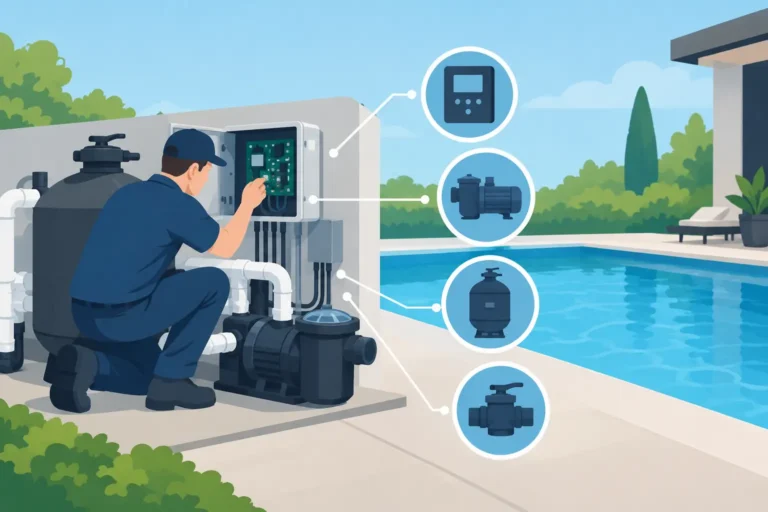
A pool that ignores its schedule can create bigger problems than an inconvenient late-night light show. When a pump does not start, a heater will not respond, or a valve stays in the wrong position, water quality and equipment protection can suffer. Professional pool automation system repair identifies whether the issue is the controller, wiring, relay, actuator, sensor, power supply, or the pool equipment itself – then corrects the actual cause.
For Georgia homeowners, automation problems often show up after heavy rain, lightning, seasonal start-up, equipment upgrades, or years of heat and moisture inside the equipment pad. The system may look complicated, but diagnosis does not have to be a guessing game. Skilled testing and a clear repair plan make the next step easier to understand.
What a Pool Automation System Controls
Pool automation combines several individual components into one control system. Depending on the pool, it may manage the filtration pump, variable-speed pump settings, pool and spa valves, lights, heater, cleaner, blower, water features, and sanitizer equipment. The controller follows programmed schedules or commands from a wall panel, remote, or mobile app.
When automation works correctly, it keeps routine equipment operation consistent. It can circulate water during the appropriate hours, switch between pool and spa modes, and prevent conflicting equipment commands. When it fails, homeowners may assume the pump or heater has gone bad. Sometimes that is true. Other times, the equipment is sound but is not receiving the command or electrical signal it needs.
That distinction matters. Replacing a working pump when a damaged relay or failed control board is the real problem adds unnecessary cost and does not guarantee the system will operate correctly afterward.
Common Signs You Need Pool Automation System Repair
A complete loss of control is not the only warning sign. Many automation failures begin with inconsistent behavior that becomes more frequent over time. You may notice the pump running at the wrong time, equipment failing to turn on through the app, lights that will not change color or turn off, or a heater that will not start even though its own display appears normal.
Valve problems are also common. If your pool will not switch into spa mode, water spills over unexpectedly, or suction and return flow seem incorrect after a programmed change, the actuator, valve, wiring, or controller programming may be at fault. A clicking sound at the equipment pad can indicate a relay attempting to engage. A blank or flickering display may point to power, transformer, communication, or circuit-board issues.
Do not ignore a controller that trips breakers, shows moisture damage, emits a burning smell, or repeatedly loses its settings. Turn off power to the affected equipment and arrange service. Electrical and low-voltage control issues can overlap, and a visual inspection alone is rarely enough to confirm a safe repair.
Why Automation Problems Can Be Hard to Diagnose
An automation panel is the decision-maker, but it depends on many connected parts. A command may begin at a phone app, travel through a network connection or wireless receiver, reach the main control panel, activate a relay, and finally send power to a pump or light. A failure anywhere along that path can look similar from the homeowner’s perspective.
For example, a pump that will not run could have a failed motor, a tripped breaker, a loose connection, a bad relay, an incorrect schedule, freeze protection mode, a communication error, or a controller that is no longer sending a signal. A technician needs to test the system in sequence rather than replace parts based on symptoms alone.
Age also affects the decision. Older systems may still be repairable with replacement relays, transformers, sensors, or actuators. However, discontinued boards, extensive corrosion, incompatible upgrades, or repeated failures may make replacement the more practical choice. The right answer depends on the condition of the existing equipment, the functions you need, and the cost difference between repair and modernization.
How a Professional Repair Visit Works
A qualified technician starts by discussing what has changed. Knowing whether the issue began after a storm, an electrical outage, a new pump installation, or a software update helps narrow the inspection. The technician then reviews schedules, operating modes, error messages, and equipment behavior.
At the pad, the inspection includes the controller enclosure, breakers, wiring connections, relays, transformers, fuses, sensors, valve actuators, and communication cables. Electrical testing helps determine whether power is reaching the panel and whether the panel is sending the correct output to each piece of equipment. When applicable, the technician may isolate a pump, light, heater, or actuator to determine whether it responds independently of the automation system.
This process protects against assumptions. A relay may be stuck closed, causing equipment to run continuously. A damaged actuator cable may prevent a valve from moving. A weak transformer can affect low-voltage controls. Moisture or insect damage inside a panel can compromise terminals and circuit boards. Documented findings give you a clearer basis for approving repairs.
Repair or Replace: Making the Right Call
Pool automation system repair is often the best value when the problem is isolated and the controller remains reliable. Replacing a relay, actuator, sensor, fuse, power component, wiring section, or communication accessory can restore normal operation without replacing the entire system.
Replacement deserves consideration when a panel has severe corrosion, multiple failing components, outdated controls that no longer support your equipment, or expensive board damage. It can also make sense when you are replacing a pump, adding a heater, updating lights, or renovating a pool. Newer automation systems may provide better scheduling, remote access, energy-management options, and compatibility with variable-speed equipment.
There are trade-offs. A new automation system can improve convenience and long-term support, but it requires proper installation, configuration, and sometimes new wiring. Repairing an older system costs less upfront, but parts availability and future reliability must be considered honestly. Coastal Pool Repairs and Leak Detection provides transparent estimates so homeowners can compare the practical options before work begins.
Protecting Your Automation Equipment After Repair
Once repairs are complete, a few habits can reduce future problems. Keep the equipment area dry and accessible, and make sure the panel door closes securely. Do not spray the controller directly when cleaning the deck or equipment pad. If an enclosure has openings, damaged seals, or visible corrosion, address it before moisture reaches internal components.
After power outages or lightning storms, check that schedules, time settings, and equipment functions are operating as expected. Avoid changing multiple programming settings at once when troubleshooting. If a function stops working after an adjustment, restoring the previous setting is easier when changes are made one at a time.
It also helps to schedule equipment inspections before swim season. A technician can identify loose electrical connections, aging actuators, worn relays, and programming issues before they interrupt filtration during the hottest part of the year.
Questions Homeowners Often Ask
Can I keep running my pool manually?
Sometimes. If the pump and electrical circuit are safe and the equipment has manual controls, temporary operation may be possible. However, do not bypass relays, alter wiring, or force valves into positions that could damage equipment. A pool with a heater, spa, water features, or variable-speed pump may need specific settings to operate safely.
Is the app always the problem when remote control stops working?
No. The issue may be the app, home Wi-Fi, a wireless receiver, controller firmware, programming, or the automation panel itself. If controls do not work at the panel either, the app is unlikely to be the only cause.
Will a power surge damage pool automation?
It can. Surge events may damage circuit boards, transformers, communication devices, and low-voltage components. A technician can inspect the panel and determine whether the controller is receiving and distributing power correctly.
A pool should make life easier, not leave you guessing why the pump is silent or the spa will not switch over. A careful diagnosis and a repair recommendation based on what testing shows can bring your equipment back under control and help you enjoy the pool with more confidence.
