

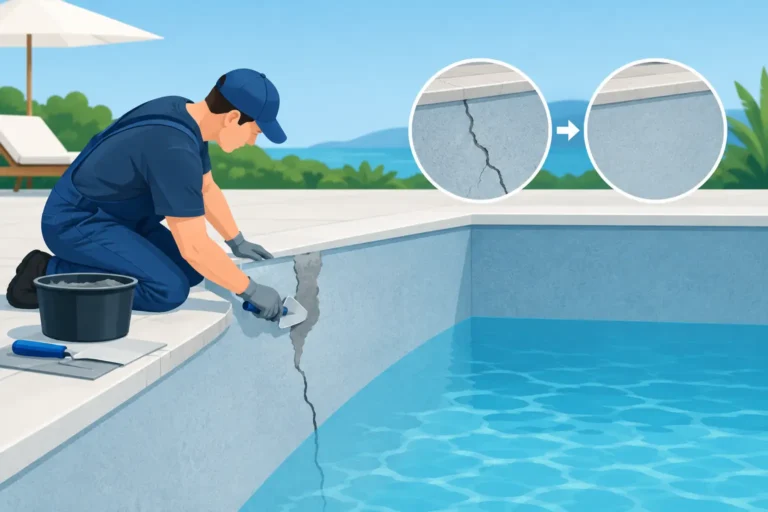
A crack in a concrete pool can be easy to spot, but its real impact is not always visible. A thin line in the plaster may be cosmetic. A wider crack, a separation near a fitting, or damage hidden beneath the finish can allow water to escape into the surrounding soil. Effective concrete pool crack repair starts by determining whether the crack is actually leaking, why it formed, and whether the pool shell is still moving.
For homeowners in Monroe and throughout the Atlanta area, that distinction matters. Sealing the visible line without finding the full cause can leave the pool losing water and can lead to another repair sooner than expected. The right approach is diagnostic first, then repair work matched to the condition of the shell.
Not Every Pool Crack Is the Same
Concrete pools are typically built with a gunite or shotcrete shell and finished with plaster, aggregate, tile, or another surface material. Over time, those layers can develop cracks for different reasons. Normal settling, soil movement, freeze-thaw cycles, pressure changes, improper drainage, aging materials, and construction issues can all play a part.
Fine surface cracks in plaster are often called craze cracks or check cracks. They may affect appearance without passing through the underlying shell. They still deserve attention, especially if the finish is worn or rough, but they do not automatically mean the pool structure has failed.
A crack that runs through the shell is more serious. These cracks may continue through plaster, appear at a corner or step, travel near a skimmer, or open and close as the ground shifts. They can cause water loss and may require a repair that addresses both the crack and the force causing it.
Cracks around penetrations also need careful inspection. Returns, lights, skimmers, main drains, and pool plumbing all create transition points in the shell. Water loss near one of these areas may be caused by a cracked fitting, a failed seal, damaged plumbing, or a shell crack. Treating every wet area as a concrete crack can result in the wrong repair.
Concrete Pool Crack Repair Begins With Testing
A pool can lose water through evaporation, splashing, a plumbing leak, equipment, a liner or shell issue, or multiple problems at once. Before repair begins, a technician should confirm where the water is leaving the pool.
A practical inspection starts with the water-loss pattern. Does the level stop dropping at a certain point? Does water loss increase when the pump is running? Is there damp soil, shifting deck material, air in the pump basket, or a noticeable drop below a return or skimmer opening? These details help narrow the search, but they are not a final diagnosis.
At Coastal Pool Repairs and Leak Detection, technicians combine visual shell inspections with proven diagnostic methods as needed. Dye testing can show whether water is being drawn into a visible crack or gap. Pressure testing helps identify leaks in isolated plumbing lines. Acoustic listening can help locate underground plumbing failures, while thermal imaging may reveal moisture patterns in certain conditions.
This process matters because a crack may be present without being the active leak. Conversely, a crack that looks small can be losing a meaningful amount of water. Documented findings give homeowners a clearer basis for approving repairs instead of guessing at the source of the problem.
Signs a Crack May Be Leaking
A visible crack deserves a professional look when it appears alongside ongoing water loss, new staining, loose tile, shifting coping, or a persistently damp area around the pool. A water level that consistently stops at the same height can also be a clue. For example, if the level settles near a light niche, return, step, or obvious shell crack, that area should be tested closely.
Do not rely on a single observation after a rainy week or a period of heavy pool use. Evaporation changes with temperature, wind, humidity, and whether the pool is heated. A controlled bucket test can help distinguish normal evaporation from a suspected leak, but it cannot identify the exact repair needed.
Choosing the Right Repair for the Crack
The best repair depends on the crack type, its location, whether it is actively leaking, and whether the shell is stable. The goal is not simply to make a crack disappear. The goal is to stop water loss and use a repair method that fits the pool’s condition.
For minor finish cracks, localized surface preparation and patching may be appropriate. The damaged plaster is removed or opened as needed, the area is cleaned, and a compatible repair material is applied. Color and texture can be blended as closely as practical, although older finishes may not match perfectly. If the plaster is broadly deteriorated, localized patches may only be a short-term answer before resurfacing is the better value.
For a leaking shell crack, technicians may open and clean the crack before applying a flexible sealing system or an injection material designed for the movement and moisture conditions present. Structural epoxy injection can be useful when a crack needs to be bonded and stabilized. Polyurethane-based materials may be selected in situations where water is active or some movement is expected. The proper material is determined by the crack, not by a one-size-fits-all product.
Some cracks require more than sealant. If there is ongoing movement, poor drainage, substantial deck displacement, or evidence of structural distress, the repair plan may need to address those underlying factors. In certain cases, that means coordinating shell repair with coping, tile, drainage, or deck work. A repair that ignores a continuing movement issue may not last.
Cracks Near Tile, Skimmers, and Fittings
Tile-line cracks and separations are common trouble spots because the pool wall, coping, tile, and deck can move differently over time. Failed grout or caulk may allow water behind the tile, but a gap can also point to a broader bond-beam or deck issue. Inspection should determine whether the problem is limited to the tile line or extends into the shell.
Skimmers deserve the same care. A skimmer leak may come from the throat where it meets the pool wall, the skimmer body, the plumbing connection, or a crack in nearby concrete. Dye testing and pressure testing help separate these possibilities before repairs are made.
Why Quick DIY Patches Often Fall Short
Pool patch products can have a place for a small, temporary surface repair, particularly when a homeowner needs to protect a rough plaster edge. They are less reliable for diagnosing or permanently repairing an active shell leak. Applying material over a crack without proper preparation may trap contamination, fail to bond, or mask the area that needs testing.
There is also a safety concern. Draining a concrete pool without professional guidance can create serious risks, including shell movement or damage from groundwater pressure. The pool should not be drained simply to inspect a crack unless a qualified professional has evaluated the situation and planned the work.
A professional repair provides a clearer scope: what was tested, what was found, what materials and methods will be used, and what part of the work is covered by warranty. That information helps homeowners compare options based on expected performance, not just the lowest initial price.
What Affects Concrete Pool Crack Repair Cost?
Repair pricing depends on the cause and scope of damage. A small non-leaking plaster repair is very different from a leaking structural crack near plumbing or a skimmer. Access to the pool, water level, finish type, crack length and depth, required testing, and whether tile, decking, or plumbing repairs are involved all affect the estimate.
The most useful estimate is specific to the findings. It should explain whether the price covers leak detection, crack preparation, repair materials, finish work, pressure testing, or follow-up verification. If a contractor cannot explain what they believe is leaking and why, it is difficult to know whether the proposed repair will solve the water-loss problem.
Frequently Asked Questions
Can a cracked concrete pool be repaired without resurfacing?
Often, yes. A localized crack can sometimes be repaired without resurfacing the entire pool. However, if the finish has widespread cracking, staining, delamination, or roughness, resurfacing may offer a more consistent and durable result than repeated spot repairs.
How do I know if my concrete pool crack is structural?
Visible width alone does not provide a definite answer. Cracks that are widening, offset, near steps or corners, associated with tile movement, or paired with continuing water loss deserve a professional shell inspection. Testing and an evaluation of surrounding conditions are more reliable than judging the crack by appearance alone.
Will a repaired crack come back?
It depends on why the crack formed. A properly repaired isolated crack can perform well for years. If soil movement, drainage problems, deck pressure, or ongoing structural movement remains, new cracking or reopening is possible. Identifying those conditions early gives the repair a better chance of lasting.
When your pool is losing water, a visible crack is a reason to investigate, not a reason to guess. A careful diagnosis, a written repair plan, and workmanship suited to the actual condition of the shell can help protect your pool, your water bill, and the seasons you planned to spend enjoying the water.
