

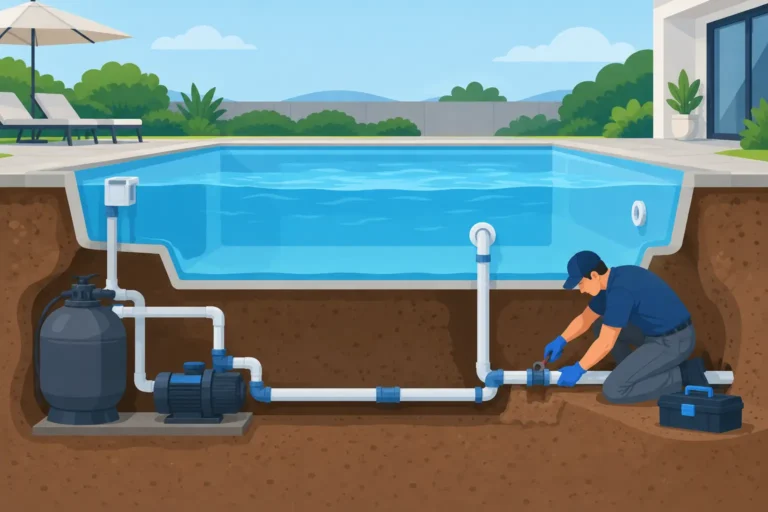
A pool can lose water for ordinary reasons, but a steady drop that continues after evaporation, splash-out, and backwashing are ruled out deserves attention. Underground pool plumbing repair is often needed when a concealed suction, return, cleaner, or spa line develops a crack, separation, or failed fitting below the deck or landscape. The water may be out of sight, but the effects are not: higher water bills, air entering the pump, weak returns, damp soil, and equipment that struggles to stay primed.
For Georgia homeowners, the goal is not to start digging based on a guess. The right repair begins with finding the failing line, confirming its location, and choosing the least disruptive repair that will hold up over time.
When underground plumbing is the likely problem
Pool plumbing leaks can look different depending on which line is affected. A return-line leak may lose more water while the circulation system is running because pressure is forcing water through the damaged area. A suction-side leak may draw air into the system instead, creating bubbles at the returns, a low filter pressure reading, or a pump that loses prime after it shuts off.
Some warning signs are more subtle. You may need to add water every few days, notice a persistently soft or wet area near the pool, or see unexplained settling along a deck section. In some cases, water loss slows or stops when the pump is off. In others, the pool loses water at a similar rate whether the equipment is running or not. That pattern is useful diagnostic information, but it does not identify the exact line by itself.
Before assuming an underground issue, a technician should also inspect the shell or liner, skimmer, fittings, lights, main drain, plumbing at the pad, and equipment connections. Concrete, fiberglass, and vinyl liner pools each have different potential leak points. A complete inspection prevents a homeowner from paying for excavation when the actual problem is accessible at the pool wall or equipment pad.
Why accurate testing comes before excavation
Excavation is sometimes necessary, but it should be targeted. Removing deck, landscaping, or soil without evidence can create unnecessary cost and leave the original leak unresolved. Skilled diagnostics narrow the repair area before work begins.
Pressure testing identifies the affected line
Pressure testing isolates individual plumbing lines and checks whether each line can hold pressure. A line that drops pressure has a leak or opening somewhere in that circuit. This process helps distinguish between a return-line issue, a skimmer line issue, a dedicated cleaner line, or plumbing connected to water features or a spa.
Pressure testing is especially valuable because pools often have multiple buried lines running close together. Knowing that one line is failing changes the scope of the repair and helps protect the lines that are still sound.
Acoustic listening helps locate a concealed leak
Once testing indicates a plumbing failure, acoustic equipment may be used to listen for the sound of water escaping underground. Pressurized water moving through soil can create a detectable sound, particularly when conditions are favorable and the leak is active.
Acoustic listening is not magic, and results can depend on pipe depth, soil type, water pressure, nearby traffic, and the size of the leak. It is one important tool among several, not a reason to skip pressure testing or a visual inspection.
Dye testing and visual inspection rule out other causes
Dye testing can reveal water movement at suspected cracks, fittings, skimmers, light niches, or liner damage. Thermal imaging and detailed inspections can also provide useful clues in the right conditions. The purpose is simple: document where water is leaving the pool before recommending a repair.
At Coastal Pool Repairs and Leak Detection LLC, that diagnostic work is paired with a clear explanation of the findings and a pre-repair estimate. Homeowners should understand what failed, where the repair is expected to occur, and what work may be needed to restore the surrounding area.
Underground pool plumbing repair options
The right repair depends on the pipe material, location, access, the condition of the rest of the plumbing, and whether the line serves an essential pool function. There is no single fix that fits every pool.
A localized excavation and pipe repair is often the best option when testing identifies a specific break, cracked elbow, failed coupling, or damaged section of PVC. The technician exposes the line, removes the compromised section, installs properly fitted replacement pipe and couplings, then pressure-tests the repaired line before backfilling. If the leak is beneath landscaping, this approach can be relatively contained.
When a damaged line runs under a large deck, retaining wall, or structure, rerouting may make more sense than cutting and replacing concrete. A new line can sometimes be installed around the obstruction and connected at accessible points. Rerouting can reduce demolition, although it may require changes at the equipment pad or pool wall plumbing. The best choice depends on the layout and the long-term condition of the original plumbing.
Some pools have plumbing that is broadly deteriorated rather than damaged in one isolated spot. Repeated failures, brittle pipe, multiple pressure-test losses, or major renovation plans may justify replacing more than one line. This costs more up front, but repeated spot repairs can become the more expensive path when the system is near the end of its service life.
After any repair, the line should be tested again before the excavation is closed. This step matters. It confirms that the repair holds pressure and that the original failure has been addressed, rather than simply covered over.
What affects repair cost and schedule
A responsible estimate reflects the actual repair scope, not just the fact that a leak exists. The major cost factors include the line involved, how precisely the leak can be located, pipe depth, accessibility, decking or landscaping that must be removed, and whether the repair requires a simple coupling replacement or a reroute.
A leak beside an open equipment trench is very different from a leak beneath stamped concrete. Likewise, a single failed fitting is different from an aging plumbing system with multiple weak points. Homeowners should be cautious of a firm repair price offered before diagnostic testing, because the location and cause determine the work.
Most targeted repairs can move quickly once the failure is confirmed and access is available. However, weather, decking repairs, permit requirements where applicable, and specialty materials can affect timing. Ask how the area will be protected, whether the line will be retested, what surface restoration is included, and what workmanship warranty applies.
What to do while you wait for service
If you suspect a plumbing leak, avoid repeatedly filling the pool without tracking the loss. Mark the water level, note whether the pump is running, and record how much water you add. If the pump is pulling air, losing prime, or making unusual noises, limit operation until the system can be inspected. Running a pump without adequate water flow can damage seals and equipment.
Do not try to seal an underground plumbing leak by adding pool chemicals, stop-leak products, or excessive amounts of sealant. Those products may not reach the damaged pipe, can complicate later diagnostics, and may affect filters or other equipment. A visible crack at a fitting is one thing; a hidden failure beneath the deck requires confirmed testing and a durable repair.
Questions homeowners commonly ask
Can a pool plumbing leak be repaired without breaking concrete?
Sometimes. If the leak is accessible from soil, landscaping, an equipment area, or an open side of the pool, excavation may avoid the deck completely. If the failed section sits directly beneath concrete, rerouting may be an alternative. The best answer comes after locating the line and evaluating access.
Is water loss always an underground plumbing leak?
No. Water can escape through a vinyl liner tear, cracked pool shell, skimmer, light niche, failed return fitting, equipment leak, or evaporation beyond what is expected. Testing the plumbing is part of a full leak-detection process, not a replacement for it.
Will the repair stop air bubbles at the returns?
If a suction-side plumbing leak is allowing air into the system, repairing that leak can restore normal circulation and reduce or eliminate bubbles. But air can also enter through pump lids, valves, unions, and worn seals, so those components should be inspected as well.
A hidden plumbing leak does not get better with time. The practical next step is to document the water loss, schedule professional testing, and make a repair decision based on verified findings. That gives you the best chance of protecting your pool, equipment, deck, and yard without paying for unnecessary digging.
