

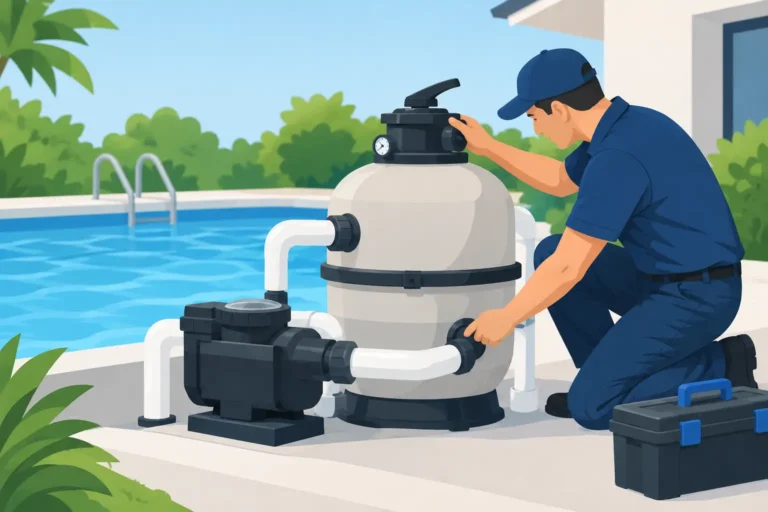
Cloudy water that returns shortly after cleaning, weak flow from the returns, or water collecting around the equipment pad can all point to a filtration problem. A qualified pool filter repair service does more than swap a cartridge or tighten a fitting. It identifies whether the issue is inside the filter, in the pump and plumbing that feed it, or in another part of the circulation system.
For homeowners in Monroe and across the Atlanta-area service network, early attention can prevent a small equipment issue from becoming a damaged pump, wasted water, or an extended period without a usable pool. The right repair begins with a clear diagnosis and a practical explanation of what needs to be fixed.
What Your Pool Filter Is Actually Doing
Your filter works with the pump to remove debris, fine particles, and contaminants from circulating pool water. The pump pulls water through the skimmer and main drain, moves it through the filter media, and returns cleaner water to the pool. When any part of that process is restricted, damaged, or leaking, water quality and equipment performance suffer.
Filters generally fall into three categories: cartridge, sand, and diatomaceous earth, often called DE. Each has different cleaning needs and repair points. A cartridge filter may need a new element, a tank O-ring, or a repaired manifold. A sand filter can develop a failed multiport valve, broken laterals, or a cracked tank. DE filters may have torn grids, damaged manifolds, air leaks, or valve problems that allow DE powder back into the pool.
That difference matters. Replacing parts without confirming the failure can add cost without correcting the underlying circulation problem.
Signs You Need Pool Filter Repair Service
A filter problem is not always obvious. Some issues start as a slight drop in circulation or a pressure gauge that slowly rises faster than usual after cleaning. Others are urgent, such as a visible crack, a failed clamp, or a steady equipment-pad leak.
Schedule an inspection when you notice several of these conditions:
- Cloudy water or recurring debris despite proper chemical balance and routine cleaning
- Low return pressure, weak skimmer pull, or a pump that loses prime repeatedly
- Water leaking from the filter tank, clamp band, valve, pressure gauge, or plumbing connections
- Filter pressure that remains high after cleaning or rises again unusually quickly
- Sand, DE powder, or filter media returning to the pool through the return lines
- Cracks, swelling, corroded fittings, worn seals, or a filter tank that will not hold pressure
Some symptoms overlap with pump, plumbing, valve, or suction-side air leaks. For example, low flow may be caused by a dirty filter, but it can also result from a clogged impeller, a failing pump motor, a closed valve, or a hidden line restriction. This is why a complete equipment inspection is more useful than guessing from one symptom alone.
A Repair Diagnosis Should Look Beyond the Filter
A dependable repair visit starts with what the homeowner is seeing: how quickly the water level drops, when the filter was last cleaned, whether the pump is noisy, and whether the pressure changes during operation. From there, a technician can inspect the equipment pad, confirm valve positions, check for visible water loss, evaluate pressure readings, and examine the filter interior and its components.
When water loss is part of the concern, the filter system should be assessed alongside the plumbing. A leak at the pump lid, a union, a multiport valve, or an underground return line can look like a filter problem because it affects circulation. Pressure testing helps isolate plumbing lines, while visual inspection and targeted testing can identify leaks at accessible equipment connections.
Coastal Pool Repairs and Leak Detection approaches these issues as a system problem, not simply a replacement-parts problem. The goal is to explain where the failure is, what repair is appropriate, and whether replacement makes better long-term sense.
Common Pool Filter Repairs
Many filter failures can be repaired efficiently when the tank and core components remain in good condition. Service may include replacing a worn tank O-ring, pressure gauge, air-relief assembly, drain cap, clamp hardware, valve gasket, cartridge element, DE grid, manifold, or damaged plumbing fitting.
Leaks around a filter tank often come from seals, unions, valves, or fittings rather than the tank itself. These repairs are usually straightforward if caught early. A cracked tank is different. Because filter tanks operate under pressure, a structural crack often calls for replacement rather than a temporary patch. A safe recommendation depends on the tank material, crack location, age of the equipment, and operating pressure.
Sand filters have their own trade-offs. If sand is returning to the pool, the problem may be broken laterals or a damaged standpipe. Repairing internal components can make sense on a sound tank. If the tank is aging, brittle, or showing multiple failures, replacement may be the more dependable option.
With cartridge filters, cleaning alone does not always restore performance. Cartridges eventually lose their ability to filter effectively, especially if they are torn, flattened, heavily stained, or coated with oils and scale. Replacing worn cartridges can improve flow and water clarity, but the technician should also check that the filter is correctly sized for the pool and pump.
Repair or Replace? Make the Decision With the Full Picture
There is no single answer for every filter. A repair is often the right choice when the tank is sound and the issue is isolated to a serviceable part. Replacing a worn O-ring, valve seal, pressure gauge, or internal component can restore normal operation at a reasonable cost.
Replacement becomes more practical when the filter tank is cracked, the equipment is obsolete, the filter is undersized, or multiple expensive components are failing at once. Homeowners should also consider the age and condition of the pump. Installing a new filter on a struggling or poorly matched pump may not resolve the circulation issue.
Before work begins, ask for a clear estimate that separates the diagnosis, recommended repair, parts, and any replacement alternatives. A transparent estimate helps you choose based on expected reliability, not just the lowest immediate price.
What Homeowners Can Do Before Service Arrives
Avoid opening a pressurized filter or loosening a clamp while the pump is running. Turn off power at the equipment, and do not restart a system with an obvious tank crack, damaged clamp, or major leak. Pressurized equipment can be dangerous when components are compromised.
You can help speed up diagnosis by noting the filter pressure before and after cleaning, taking a photo of visible leaks, and observing whether water loss occurs only while the pump runs. Also note whether the water level falls below the skimmer when the system is off. These details can help distinguish equipment leakage from a possible pool-shell or plumbing issue.
Routine maintenance still matters. Clean cartridges according to manufacturer guidance, backwash sand and DE filters only when pressure indicates it is needed, maintain proper water chemistry, and keep leaves from overwhelming the skimmer basket. Over-cleaning or excessive backwashing can reduce filtration efficiency and waste water, so the right schedule depends on your specific filter and pool use.
Questions Homeowners Often Ask
Can a bad filter cause a pool to lose water?
A damaged filter tank, worn valve seal, loose union, or leaking plumbing connection at the equipment pad can absolutely lose water. However, water loss may also come from underground plumbing, the skimmer, the pool shell, tile line, or a vinyl liner. Testing is the most reliable way to locate the source.
Why is my filter pressure high right after cleaning?
A high reading after cleaning may point to a blocked return line, a valve issue, an incorrect gauge, overfilled DE, compacted sand, or a problem inside the filter. It should be inspected rather than repeatedly backwashed or forced to run under excessive pressure.
How quickly should a filter repair be scheduled?
A visible leak, cracked tank, electrical concern, or complete loss of circulation deserves prompt service. For cloudy water or gradual pressure changes, scheduling soon can keep the problem from worsening and help protect the pump from strain.
A pool should feel like part of your home, not another source of uncertainty. When circulation changes, pressure rises, or water appears around the equipment pad, getting a professional diagnosis early gives you the clearest path back to clean, dependable water.
